




Burnham Bounce Backfires
Glenigan's 3-month data shows construction is still struggling, with overall starts down 20% year-on-year and residential not getting any lift from the expected Burnham Bounce.
Residential construction starts fell declined 15% against the preceding three months and dropped a whopping 36% compared with the previous year.
The September 2026 edition of the Glenigan Construction Index focuses on the three months to the end of August 2026, covering all underlying projects, with a total value of £100 million or less, with all figures seasonally adjusted.
No Burnham Bounce
This issue of the Index shows that the construction industry has not seemingly benefitted from the Burnham Bounce, expected over the summer. Far from firing on all cylinders, the sector continues to stall against a backdrop of ongoing economic uncertainty, stubborn borrowing costs and lingering investor caution.
2027 recovery
However, despite poor year-on-year performance, with project starts down 20% compared to 2025, results held relatively steady against the preceding three months, only dipping 2%. It indicates that, whilst the sharpest drops may be behind us, there’s still a steep hill to climb before we see the 2027 recovery predicted in Glenigan’s most recent Summer Forecast.
Residential lagging
Getting to the heart of what’s holding back recovery, residential remains the sector's biggest laggard. In the private sphere, developers review the viability of sites in response to weak house sales and higher construction costs including the impending building safety levy.
Council & social housing
Yet it could be a different story for social housing in the coming months with Number 10's renewed commitments to housebuilding, giving the industry potential cause for optimism in the coming months; especially if there are new public spending commitments for these types of projects in the Autumn Budget. Whether this will translate into shovels in the ground in the short-term remains to be seen, yet it will help to shift the mood of a vertical that remains stubbornly stagnant.
Other sectors
Office starts, primarily driven by commercial fit-out and refurbishment, continue to perform impressively with industrial and health showing an encouraging uplift, edging the vertical slightly ahead year-on-year.
Commenting on the Index, Glenigan’s Allan Willen said: “After a rough start to the year, it's fair to say the sector caught its breath over the summer and whilst activity levels remain painfully low, they have stabilised. It’s a positive sign that the freefall, which began in Q.2 has finally ground to a halt. That said, we're not exactly climbing yet.
“The real bright spot is non-residential, but a fresh cabinet, headed up by a new Prime Minister with new priorities could easily change things. Even the sectors doing well have caveats attached.
“Office fit-outs continue to hold up, although with occupancy rates remaining stubbornly low, it begs the question will developers keep backing new schemes.
“Meanwhile, residential remains a drag on overall activity, as developers weigh up site viability against higher construction costs and the looming building safety levy.”
Residential – private housing
Private housing was the largest component of activity, with various projects supporting overall activity. However, the sector remains stuck in reverse declining 8% against the preceding three months and plummeting 37% lower than a year ago.
Social housing
Social housing experienced a particularly weak period, with a steep drop falling 29% against the preceding three months and declining 30% on the previous year.
Regional outlook all sectors
The North-West surged 46% against the preceding three months, standing 8% above the previous year.
Yorkshire also performed well, climbing 43% quarter-on-quarter and remaining a healthy 11% above last year's level.
The East Midlands advanced steadily too, rising 27% against the preceding three months and standing 4% up on the previous year.
London was relatively stable, dipping just 6% against the preceding three months but remaining 2% higher than a year ago.
Wales lowered 13% quarter-on-quarter but it stands 14% above last year's level.
Whilst the South-West rose 7% quarter-on-quarter, it remained a staggering 35% behind last year's figures.
The North-East slipped 19% against the preceding three months and trailed 30% below last year's level.
Scotland fell 9% quarter-on-quarter and 32% year-on-year. Northern Ireland declined 32% against the preceding three months and stood 11% below the previous year.
The East of England declined 28% against the preceding three months and stood 34% below the previous year.
The West Midlands weakened by 18% against the preceding three months and plummeted 41% lower than a year ago.
The South-East also weakened sharply, tumbling 29% quarter-on-quarter and 43% year-on-year.
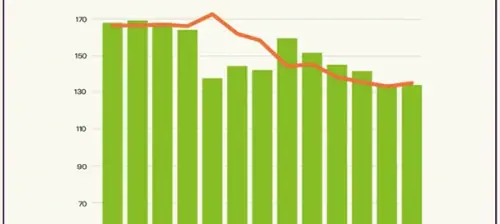
Picture: The Glenigan Index of construction starts below £100 million.
Construction recovery is yet to materialise despite non-residential growth. Residential is in the doldrums.
More To Read