





The Weakest Link
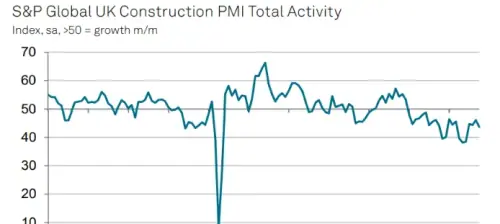
Weaker and weaker housing activity has weighed on the overall UK construction sector in October as building firms signalled a sharp and accelerated reduction in business.
Joe Sullivan, a Partner at MHA said: “The worse than expected drop in Purchasing Managers Index (from S&P Global) data in October highlights that high borrowing costs, weak demand and persistent delays are continuing to hold projects back. Housing remains the sector’s Achilles’ heel, as households refinancing mortgages at much higher rates face a substantial squeeze on spending power and confidence, feeding straight through to housebuilders and their supply chains.
“The measures announced in the Budget to support first-time buyers and social housing have been broadly welcomed by the sector and could help the medium-term outlook, yet they are unlikely to provide an immediate boost.
“The first-time buyer scheme is relatively modest and will not open until 2027, while higher taxes on landlords could further restrict rental supply and push rents up. Measures to reduce household energy bills may offer some relief but they do not offset the broader affordability challenge.”
Not a recovery
Sullivan added: “The real test is whether new orders strengthen and projects move through planning, funding and procurement onto site. Until that happens, any improvements in the headline PMI over the months to come should be treated as a modest stabilisation after nearly two years of contraction rather than a meaningful recovery.”
Down, down, deeper and down
At 43.6, down from 46.1 in September, the headline seasonally adjusted S&P Global UK Construction Purchasing Managers’ Index which tracks changes in total industry activity, registered below the neutral 50.0 value for the twenty-second month running. Moreover, the rate of contraction was the steepest since June.
Residential activity (index at 35.1) was by far the weakest performing segment, with the latest reading the lowest since December 2025 and indicative of a steep drop in house building.
Anecdotal evidence cited low consumer confidence, elevated risk aversion and headwinds from rising borrowing costs.
Insights
Tim Moore, Economics Director at S&P Global Market Intelligence, said: "October data indicated a setback for the UK construction sector after some signs of stabilisation in the previous month. Business activity decreased at the fastest pace since June amid the steepest reduction in residential work so far this year.
"Construction companies commented on severe headwinds in the house building sector from rising borrowing costs, weak consumer confidence and elevated economic uncertainty.
“However, there were reports of strong demand for data centre projects, alongside rising workloads in the energy and utilities sectors. Resilient infrastructure spending contributed to the slowest fall in civil engineering activity since May 2025.
"On the supply side, there were again delays with deliveries for construction products and materials. Moreover, input price inflation intensified, largely due to fuel surcharges and higher energy costs. Almost half of the survey panel (48%) indicated an increase in their input costs in October, up from 25% in September."
Picture: The Purchasing Managers Index for October 2026.
The October Purchasing Managers Index from S&P Global has shown the sharpest fall in total construction activity since June, with residential work declining at its fastest in 2026.